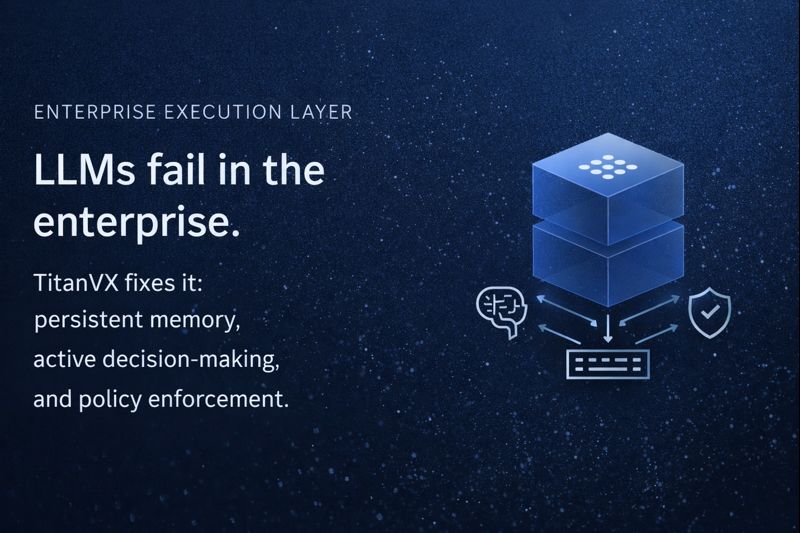
LLMs are the language interface. Atlas is the execution layer around any model—adding persistent memory, constrained decisioning, policy enforcement, and audit trails—so enterprises can deploy AI with accountability.
LLM
Natural language output. Fast iteration. Not governance.
Atlas
Cognition + governance: memory, decisioning, policies, audit trails.
Eventium
Orchestration: perception → reasoning → knowledge loop.
Titan Exchange
Distribution: governed agents, workspaces, licensing, revenue.
Workflow
TitanVX is the marketing surface. The stack is built from Atlas (execution), Eventium (orchestration), and Titan Exchange (distribution). This is how enterprise AI moves from demos to deployable systems.
Use any LLM (e.g., GPT-5.2-class models). The model generates language—Atlas governs what the system can do with it.
Atlas turns responses into controlled actions: persistent memory, decision constraints, policy blocks, and auditable traces.
Governed agents go live: workspaces, listings, licensing, upgrades, usage tracking, and revenue—built for enterprise distribution.
Technology
Titan is not “an LLM company.” We don’t compete with foundation models—we augment them with enterprise cognition and governance primitives that are hard to retrofit.
Atlas provides durable memory objects and structured knowledge updates so systems improve and stay consistent over time.
Move from “helpful text” to governed execution: decision boundaries, permissions, and policy blocks that define what’s allowed.
Enterprises need proof. Atlas produces traceability that supports compliance, incident review, and accountable automation.
Anchor outputs to evidence (sources, timestamps, frames) so intelligence can be reused safely—and licensed with trust signals.
Foundation models will keep improving. The defensible edge moves to what runs around the model: governed execution, compounding memory, verifiable provenance, and distribution infrastructure.
Vector search retrieves “similar text.” Eventium structures meaning into a living hypergraph (entities, actions, time, causality), so agents reason over relationships—not just nearest neighbors.
Memory, policy blocks, constrained decisioning, and audit trails aren’t prompt tricks. They’re execution infrastructure—designed to hold up under enterprise scrutiny.
Titan Exchange turns governed agents into deployable products: workspaces, licensing, upgrades, and usage-based revenue—distribution built into the stack.
LLMs are the language interface. Titan’s moat is everything that makes intelligence persistent, governed, and distributable.
| Capability | LLM-only | Vector-first RAG | Titan (Atlas + Eventium + Exchange) |
|---|---|---|---|
| Persistent memory | Session-only | Doc recall ≠ memory | Memory primitives + updates |
| Decisioning under constraints | Prompt-based | Prompt + retrieved text | Policy blocks + governed automations |
| Audit trails | Best-effort logs | Retrieval traces | Execution-grade auditability |
| Provenance | Rare / manual | Citations, not proof | Anchored evidence + trust scoring |
| Distribution + monetization | External build | External build | Native Exchange marketplace + workspaces |
Products
Each product is a layer. Together, they form a closed loop where intelligence compounds instead of resetting.
The execution layer around any LLM: memory, decisioning, policy enforcement, and audit trails. Atlas makes “AI output” safe to deploy in production environments.
Unified intelligence flow: OmniSight perception → Eventium Agents reasoning → Titan Exchange distribution → Genesis creation. A living cycle where every insight strengthens the next.
Where governed agents go live. Launch customer workspaces, publish deployable agents, bundle governance rules, control access, and track adoption—built for enterprise distribution.
OmniSight ingests video, audio, and images into structured knowledge. Genesis transforms verified intelligence into artifacts: visuals, narrated briefings, and simulations.
Audio, video, image, or text—captured without special formatting.
Processed inside Eventium’s environment to preserve privacy and context.
Entities, actions, and temporal relationships mapped into structured form.
Marketing, finance, legal, or custom domain agent receives the task.
New facts, relationships, and evidence strengthen the system over time.
Contributions scored for quality and trust to improve incentives.
Structured requests cross-reference existing KBs to stay evidence-anchored.
Precise output tied to sources, timestamps, frames, or verified records.
Verified insights become images, narrated briefings, and explainers.
Agents publish and license intelligence with provenance transparency.
Tools
One gateway into identity, Atlas execution, governance rules, marketplace operations, and Stripe billing. Everything lives in the Developer Hub—no redundant “corners,” no scattered CTAs.
Interactive reference for Titan identity, Atlas automation, chat relay, governance rules, listings, and billing.
Atlas is referenced throughout the Developer Hub because it powers execution behind domains, rules, chat, and automation.
Launch workspaces, publish governed agents, bundle Streams + Rules, and monitor usage and revenue.
Company
AI shouldn’t be a single, isolated model. The future is a network of specialized agents that retain context, reason under constraints, and collaborate—while producing auditable outcomes.
The next era of AI is distributed: perception + reasoning + governance + distribution. Systems should improve with use, not reset with every prompt—while remaining controllable and provable.
Atlas for execution and governance, Eventium for orchestration and knowledge loops, Titan Exchange for distribution and monetization. TitanVX is the surface that tells the story.
AI R&D — Former Lead Software Engineer in the Security & Defense industry. Leads AI innovation initiatives.
AI Strategy & Execution — Background as EVP of Product & Marketing in Space & Defense. Drives strategy and implementation.
AI Cloud Infrastructure — Previously a Lead Cloud Engineer in Satellite & Cloud. Ensures infrastructure is robust, scalable, secure.
Investment
The platform strategy is structural: as more governed agents deploy, the system accumulates provenance-verified intelligence and reusable automation patterns.
Execution moat
Atlas governance primitives are difficult to replicate via prompts or wrappers.
Data moat
Provenance + trust scoring produces reusable intelligence, not disposable chats.
Distribution moat
Titan Exchange turns internal agents into products with licensing and revenue.
Model leverage
Model-agnostic. Capture upside as foundation models improve.
Enterprises don’t buy “a model.” They buy outcomes with governance: permissions, policies, auditability, and safe distribution. Titan packages those necessities into a cohesive platform.
Atlas execution primitives scale across domains. Eventium orchestrates multimodal intelligence. Exchange scales distribution and monetization. Together, they form a compounding loop.